Wednesday, 6 June 2012

The Royal Research Ship 'Discovery'. Part 15.

Making a Start on the Inner Hull

It is easy to be wise after an event as many of us will admit, and such was the case regarding the conservation of the inner hull of Discovery. During the late 1980s and early 1990s many features had been built in the inner hull to provide better visitor interpretation of their surroundings. These interpretations effectively enclosed parts of the inner hull of the ship, especially the starboard side. During the Full Structural Survey the surveyor was limited to how much of the inner hull he could survey without opening up these structures that had been built to provide a better visitor experience. Ideally they should have been opened up and re-built afterwards. However, finance was limited and only that which was affordable was surveyed. The Survey Report was noted to that effect. Now that the real work had started I had time and opportunity to do a more in-depth survey and had started while work was proceeding on the outer hull. In gaining access behind the interpretative structures I found damp and decay. How could this have happened? Easy! Cut off ventilation; moisture will collect and find unprotected timber surfaces that it will inhabit at will then decay and related fungi will result. A typical example of this was found in the Boiler-room of the ship and the following sequence of pictures amply illustrates the effect of enclosing spaces. A replica boiler had been built on the port side of this space and, since originally there had been two boilers, a mirrored structure had been built on the starboard side to give the illusion of a second boiler.

Boiler-room before mirror structure was removed.
During removal.
After removal revealing the dam and decay on the ships side
due to lack of ventilation.
The Engine Room of Discovery had remained virtually the same as it had been after the removal of the machinery during the Second World War. It was in a sad state, neglected but containing many interesting features that cried out to be seen, so it had been planned as part of the overall Project, to renovate the space and open it up to the visiting public. The space demonstrated the heavy structure of the Oak frames around the stern. Other features included the mechanism that allowed the crank-shaft from the engine to be disconnected from the propeller allowing the latter to be removed and hoisted up to deck level should repairs be needed, or if it needed to be protected from ice; there was the position where the distillation plant had operated; valves that controlled the access of sea-water to cool the engine; a structure supporting the base of the Mizzen Mast; the huge engine mountings. All were scheduled to be opened up, repaired, replaced, restored where possible and conserved. Given its condition, the work to be done had to reflect the history and use of the space and needed to be carefully carried out.

The Engine room space in the process of being restored.
The same space washed and drying out.
The schedule of work in the inner hull dictated that it should start in the engine-room and work forward in the lower holds of the ship. Ballast in the form of Pig Iron ingots was stacked between the bottom frames and the space under the Boiler-room was first to be opened up and where the extent of the freshwater ingress into the inner hull from the upper deck became apparent.

The depth of the fresh water allowed to accumulate is evidenced by the rust
coloured line on the ballast ingots that themselves are welded together by corrosion.

The first step was to dry the whole spaces out. Electric driers were hired and placed where they would be most effective. Humidity readings were taken at regular intervals and the moisture content of the damp timbers was monitored using non-evasive probes. Slowly the air and timber conditions improved. The opportunity was taken to lift the ballast ingots from where they were stowed, thoroughly clean and paint them with a protective coating. It was obvious that if the ingots were exposed to moist air or water again corrosion would result. Shrink wrapping, using a heavy polythene material, was the simple answer but not before the ballast spaced had been cleaned and treated with a proper protective coating.

Ballast stacked neatly and protected.
Next to the Engineroom was the Boiler-room I have already referred to. The replica boiler was a substantial structure with a tiny door built into its left side to allow entry into the inner boiler. Within this replica a ventilation unit had been placed 17 or 18 years previously. The damp conditions within had taken their toll and the unit had ceased to function some time before we gained entry. Another problem! This time one that had been anticipated during the planning stages of the Project. It had been obvious from the beginning that heating and ventilation of the inner hull had to be better controlled. It would have been ideal if a state of the art system could have been provided but that may well have compromised the declared intention to preserve as much of the original materials as was possible. Anyway, the bottom line was that financially we couldn't afford such a luxury. After much research and advice it was decided that portable, thermostatically controlled (fitted with a manual over-ride), individual, heating and dehumidifying units were the answer. These units would be placed throughout the inner hull and a system devised to remotely monitor the air conditions, so that alterations could be made to the settings on the units whenever the need arose.

Next. Further detail on the progress of the Project.

Tuesday, 5 June 2012

The Royal Research Ship 'Discovery'. Part 14.

More Surprises - More Original Material

The bottom plank fastenings problem was solved by inserting over-sized new 'dumps' (a historical name for the steel fastenings), hammered well home with a winding of cotton twine around the head of each. The head was hammered about a centimetre below the surface of the plank and capped with a wooden dowel (plug). The fitting of Zinc Anodes was left to be done just before the ship was re-floated.

Now we turned our attention to the hull plank seams. It had been estimated that about 40% needed to be re-caulked and sealed. Wrong! Closer examination showed that more than 80% needed to be treated as much of the sealant was no longer effective. The white or red lead mix used in the past as the final sealer could not be used again because of its toxic properties under Environmental Regulations. An alternative had to be found. There are very few supply companies remaining in the United Kingdom who stock maintenance materials used in historical wooden ships. After some investigation a small company was found that could provide the material to the specifications we required. It had to be flexible and remain flexible but at the same time, seal the seams. The supply company had experimented until it had found the right non-toxic mix, found it a marketable name and made it available to clients such as Discovery. It was the name of the material that raised and eyebrow and a laugh! Black Pudding Mix, it was called; black pudding being a favourite breakfast food for many Britons. Our Black Pudding Mix was not edible but entirely suitable for the work it was meant to do - seal the plank seams.

Black Pudding in a can!
The Shipwright sealing the plank seams with Black Pudding Mix.
A closer view of the sealant and application.
The process completed on 80% of Discovery's outer hull was delicate and oft-times awkward work. Each finished seam and joint was inspected. The outer hull consisted of three different types of wood, each having its own particular properties. English Elm formed the bottom planks giving way to Pitch Pine in the upper hull, however, Greenheart, that wood of all woods, that near-indestructible timber, that heavy, solid, super timber was used as a protective sheathing at the bow and down each side from above the waterline to meet the Elm planking below in order to provide protection from the ice.

You will gather that I am a great fan of Greenheart timber that grows in tree form to ah height of over 40 metres and can have a trunk diameter of more than a metre. A majestic hardwood found in Guyana and in parts of Venezuela, Surinam and Northern Brazil, it has the capacity to be nearly resistant to marine borers and decay fungi. All in all it is the ideal timber for underwater structures.

Again I have allowed myself to become distracted. Back to the Discovery and bottom repairs. Good progress was made after the initial set-backs and budget savings were made in relation to original estimates. The survey report had recommended that 14 bottom planks should be replaced but after further investigation, it was considered sufficient to rout out the surface decay and insert filling pieces where they were needed. In this way original timbers were restored and kept in place. But budget savings in one area were offset by overspend in another. The cost of re-caulking and sealing the plank seams rose by 100% and swallowed up any apparent savings from other areas.

Progress in restoring Discovery's hull planking.
It was known that water was leaking into the forward end of the ship where steel plates were mounted on top of the timbers at the bow to provide further protection from ice damage. The leak was discovered beneath a section of these plates. To remove them in order to repair the leak would be expensive, destructive and amount to vandalism of a historic artifact; it was out of the question. It was also known that Discovery's hull, especially at the bow, had been built exceedingly strong. Apart from the steel protection plates, Greenheart planks lay beneath and Pitch Pine below the Greenheart. Then there was an inner ceiling of Pine. Innovation had to be introduced and it was. A small hole was drilled through the Greenheart at the aft edge of the steel plates. When the drill penetrated the Greenheart to its whole thickness and entered the Pitch Pine, the reduced effort of drilling would be felt immediately. That was the moment to stop drilling. A long grease nipple was then inserted into the hole in the Greenheart timber and screwed home. Then an environmentally friendly sealant was pumped under pressure between the Greenheart and Pitch Pine plank layers. This spread out between the layers effectively providing a watertight membrane to seal the leak. The cost of doing this was minimal and the reward was that yet again the historic integrity of the ship had not been compromised and could remain preserved for the enjoyment of future generations.

It would be unwise of me to go into further detail of the work done to the lower hull, that would take too much space and could become boring to some. So I will move on in the next parts and explain what was found and done in the inner hull. I'll leave this one with a picture of Discovery's lower hull planking nearly completed.

Monday, 4 June 2012

The Royal Research Ship 'Discovery'. Part 13.

More Surprises and Problems

You will remember that we had removed a small piece of plank from the ship's bottom for examination, particularly to look for the presence of Teredo Worm and luckily, none was found.
The type of timber was English Elm, well known for its durability in sea water and used extensively in the lower hulls of wooden ships prior to the 1850s. When the small piece was cut out, apart from some surface wear, the rest of the plank was in the same condition as it had been when it was assembled there in 1924. These bottom planks were substantial, each measured at least 28 cms wide, up to 20 cms thick and 10 metres long, fastened to the bottom Oak frames, themselves up to 30 cms square section. What drew our attention most was how the plank seams had been sealed. The shipwrights of 1924 had inserted up to 12 layers of Oakum (caulking material made of tarred and spun hemp) into each seam, each individually hammered home tight into the seam.

Strands of Oakum that had been hammered into each plank seam.
A crude calculation tells us that the overall length of the Oakum strands in the seams of Discovery's planks, laid end to end, would stretch to over 11 kilometres! The seams were finally sealed with a white lead putty mix (illegal today because of its toxic properties).

The removal of this small piece of plank provided another, unfortunate, challenge. The steel fastenings had worn, producing a black liquid substance that oozed between the wood and the fastening. Immediately a further survey was made of the whole of the ship's bottom, this time concentrating on the fastenings, looking for evidence of the black liquid material found at our examination site. The outcome of that survey was not good news! Many of the fastenings, especially the one third ships length from the stern, showed signs of distress. Every fastening that showed signs had to be inspected further. The result was breathtaking! Over 100 fastenings were removed, some showed mild corrosion, others severe and at some of the sites the fastening had corroded to leave nothing but a black void hole in the plank.
A corroded steel fastening being removed.

Examples of fastenings removed in various states of corrosion.
The short example in the middle is what the original girth and shape was.
Wooden plugs inserted where corroded fastenings had been removed. The letter 'N'
in chalk beside each fastening position indicates fastening totally corroded away.

So what had caused this phenomenon? After much scratching of heads and examination of the evidence it was decided that there were two culprits, one visible and the other invisible. The visible one was the ingress of fresh water (rainwater) into the inner hull of the ship causing some areas, where the ships inner-bottom was unprotected, to allow this fresh water to seep into the planks and then find its way down the sides of the fastenings. The invisible one, much more worrying, was the electrolytic currents within the water in the dock itself slowly corroding the steel fastenings. How long this had been going on was difficult to tell. It could well have started when the ship first lay in London in 1932.

To explain Electrolytic Corrosion in layman's terms is difficult. Let me try! First, we must have electricity. Second, we must have cables that carry that electricity. Third, we must have a static, floating object that is held together by metal fastenings and last, water, that wonderful conductor of electricity. Put these together and what do you get? electrical currents set up within the water desperately searching for a way out through an earth connection. In the case of Discovery, her steel fastenings, metal plates and other metal fittings in or on the underwater hull were targeted. The fastenings and fittings became electrically charged setting up a chemical reaction in their immediate area that attacked the metal, corroded the metal and ultimately when left unattended, destroyed the metal.

While she was in London live cables would have been at or near the dock side or near the Embankment where she lay for so long. A constant supply of electricity would have been fed on board by a cable or cables. In Dundee electrical cables surround the ship on the quayside to the North, East and West of where she lies. a 240v constant electrical supply is fed on board by cable from the quayside. So all the elements that cause electrolytic corrosion are or have been present around the Discovery for the past 80 years or so.

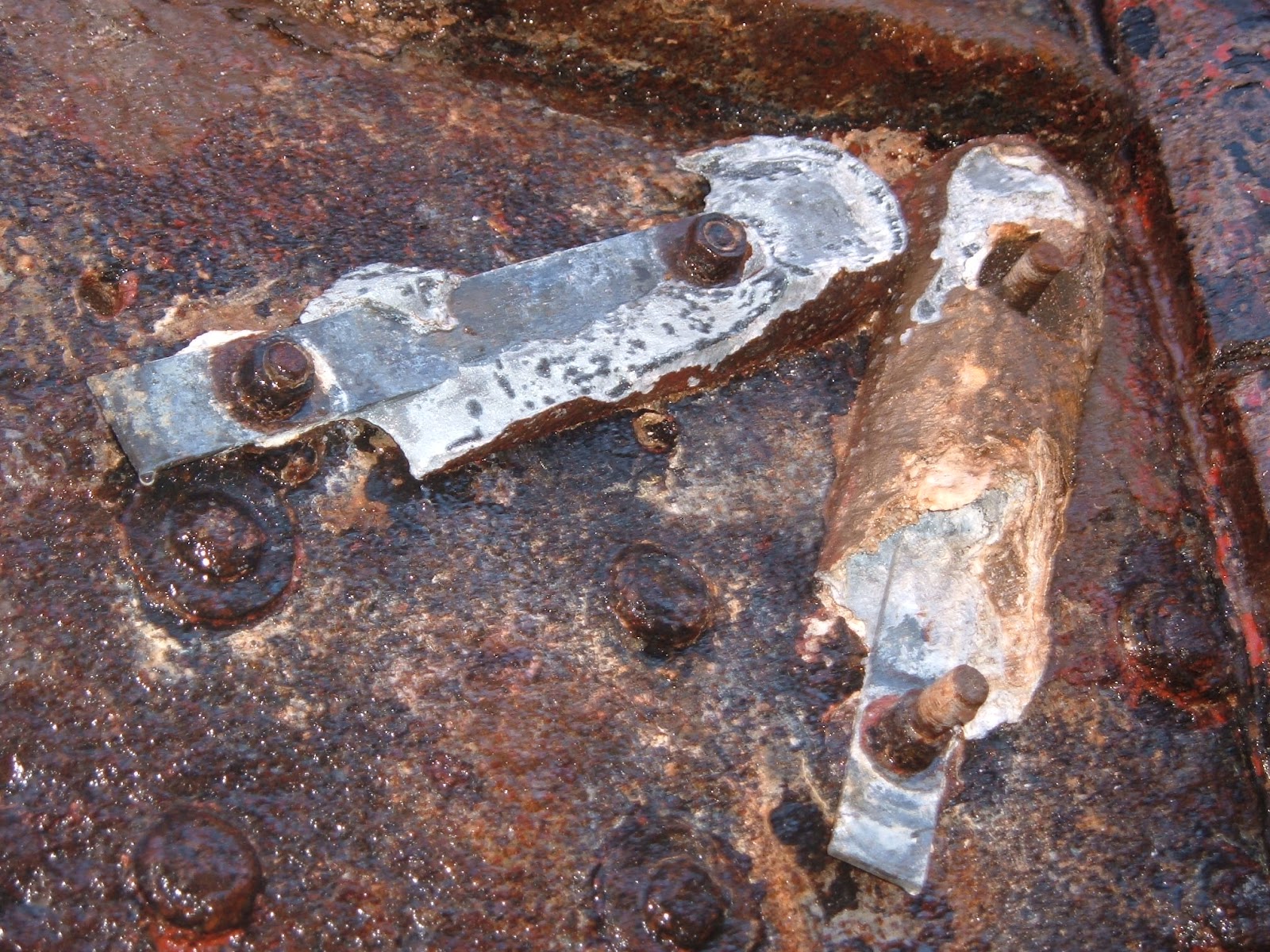
what can be done about it? Well, the secret is to provide those electric currents with what they want - an earth escape! Not an ordinary earth escape but one that provides the current with least resistance, one that has been tried and proven beyond doubt. Zinc is the most commonly used metal to protect steel from the ravages of electrolytic corrosion. It comes in many forms but the usual is in rectangular blocks in ingot form. Companies who specialise in Cathodic Protection provide both the amount required to suit any given case and advise on how best to fit the protection. These Zinc Anodes have a finite life and cease to be effective when they reach a stage where they have almost completely oxidised, therefore, they should be renewed every 12 to 18 months in order to continue the protection from corrosion. The picture shows the state of two anodes that were fitted on Discovery's stern post near the propeller; they are long past their sell-by date!


Next. The Project continues with more challenges in store!

Saturday, 2 June 2012

The Royal Research Ship 'Discovery' Part 12.

The 2007 - 2009 Restoration and Conservation Project - The Start

It was a dull, damp and cold morning in March 2007 when the Main Contractor and his men assembled at the dock-side at Discovery Point to begin the Project. The mood was buoyant, it was if  Discovery felt that at long last she would have all her ills cured, although she was yet to give up her secrets of how bad things had become. I have already referred to the difficulty of cleaning the dry-dock to allow work to begin in earnest but that was accomplished and all was ready to start on the physical work.

Discovery settled on blocks ready for the start; April 2007.
The first task was to remove as much of the old paint coating as possible without harming the original timbers. High pressure water jets were to be used but here the first obstacle was encountered. If ordinary high pressure water jets were used, the shape of the jet itself could do damage to the timbers, especially at pressures beyond 8,000 psi. At such pressures a concentrated water jet would tend to cut through the timbers like a knife. Not a good idea! A specialist North Sea Oil support company, in consultation with the Main Contractor, came up with a novel idea, probably a first. Why not design the jet head so that it rotated at high speed thereby avoiding concentrating its energy on one spot for an instant? Trials proved successful and stripping began.

Stripping starboard side
The water-jet in skilled hands


As the timbers were cleaned it soon became evident that some of the findings reported in the Survey Report were wrong, especially that of the presence of Teredo Worm. Now the Teredo Worm is the scourge of wooden ships. These creatures begin as a microscopic larvae, entering the timber of a wooden ship where surface damage may have occurred. They gorge on the timber, burrowing into the plank, growing all the time. Soon they lay their own eggs in a bunch; these hatch and start burrowing in a different direction to that taken by the parent. All this takes place within the timber, out of sight of human eyes. They can grow up to a metre in length and have a girth up to two centimetres. That makes for a big hole!! The underwater timbers of a wooden ship can become cris-crossed with these invisible tunnels, so much so that they lose their strength and break up to cause misery to sailors and owners alike. During the centuries up  to the 19th many, many wooden ships were lost at sea; initially this was put down to storms and tempests, rocks r reefs. However there were many unexplained losses even in the calmest of conditions; there can be little doubt that the Teredo Worm was the culprit for many maritime disasters. Think about a large wooden merchantman, sailing somewhere in the middle of the Mediterranean on a clear, near calm night. Only the Officer of the Watch, lookout and helmsman are awake; the crew are below sleeping. Suddenly, the ship breaks her back, water floods into the hull; the bow and stern rise to meet each other, then slowly slide down into the deep. It may have been all over in less than a minute! No warning given, no chance of escape! How many seamen perished in such a fashion is difficult to say but the number would have been thousands rather than hundreds over the years.
 
So the report that Teredo Worm might be present in Discovery's hull was worrying and an immediate investigation was necessary. I selected a plank that showed some signs of worm activity and had a section cut out.
 
 
Cutting out a section of Elm Plank on the starboard forward side for examination.
Careful examination revealed that the worm signs were confined to a depth of less than one centimetre into the plank. It was not Teredo; it was not active and it was as if a great burden had been lifted from all of our minds. Such a condition could be dealt with and deal with it we would. In removing this small piece of plank, other things came to light that I'll tell you about in the next part.

Friday, 1 June 2012

The Royal Research Ship 'Discovery. Part 11.

Historic Wooden Ship Conservation and Restoration - The Reality

I pick up the story of the Discovery again from the year 2000. She had been moved to her new abode, Discovery Point, Dundee, in 1992 under a blaze of publicity. Now she was permanently at home in her custom built dock looking out over the lovely River Tay Estuary; the historic railway bridge, built in 1882 upstream; the road bridge, built in 1964, downstream. It was and is an idyllic setting!
As in many other high profile developments, consultant's forecasts of visitor numbers and therefore estimated revenue generated had been encouraging, sufficient to justify the building of the dock, visitor and conference centre in the first instance. The first two years were a great success with people coming from all over the world, never mind locally, to see the new attraction. Thereafter visitor numbers started to slide, slowly at first then, year by year, grew less and, as a consequence, revenues grew less. During the years of plenty staff had been increased, not by much, but enough to increase the salary outgoings to a level that became unsustainable. During the year 2000 a complete review of the business took place under the stewardship of a new Chairman of the Trust. Inevitably, costs were pruned, jobs were lost and maintenance suffered. Two years later in 2002 the business gradually recovered and I was commissioned, on a voluntary basis, to review a Full Structural Survey of Discovery completed a few years earlier. As a result of that review it was concluded that the Survey Report was no longer relevant and a new survey had to be done.

Such an operation does not come cheap, financial assistance had to be found. The only body in the United Kingdom that could provide the assistance needed was The National Heritage Lottery Fund. However the process of convincing that body it should provide help was long and detailed, resulting in many meetings and form filling. However, in saying that, the process was transparent and fair and the Edinburgh Offices of the Fund provided whatever assistance it could along the way. In early 2004, good news! The Heritage Lottery Fund (HLF), agreed to support the project. Tenders were sent out to potential contractors and returned completed. A Preferred Bidder was selected and a Marine Consultancy Company contracted to do the work. The total cost of the Project was estimated at £52,000 (US$81,700 in today's terms), including Project Management and, after bidding for the latter I was appointed Project Manager.

A day and date was set to dry-dock Discovery to begin the Survey. The day arrived and unforeseen difficulties immediately came to light. The ship had not been dry-docked for more than seven years and during that time silt had accumulated in the dock to a height of more than a metre in places. Her underwater hull could not be surveyed before the silt was cleared; the budget was finite and the timescale tight. The silt was of a river-borne nature so it could and had to be returned to whence it came. The quality of the silt was such that it was easily identifiable, in that when Discovery was afloat and the level of the dock water needed to be restored river water at high tide was allowed to enter the dock system. The tidal flow in the Estuary, although complicated to some, is well known to others who have studied it, researched it and wrote learn-ed papers on it. When high water was reached in the river beside Discovery's dock the profile of the water layer density would have been low at the surface gradually becoming more dense with depth as the outgoing fresh water from the River Tay mixed with the saline water of the flood tide. It was therefore safe to assume that the source of the water used to restore the dock level, given the level of the inlets, was river water mixed with the clean salt water of the incoming tide. This assumption was important. If there had been the slightest likelihood that the silt could have been contaminated by, say, heavy metals, then its disposal would have been costly and time-consuming. As no sources of heavy metals existed upstream and heavy rains or snow melt would, at times increase the river's out-flow volume, any river-borne silt would be a composed of earth and vegetable matter. So it proved to be.

Innovations in the form of high pressure water pumps with a high lift, manpower on the dock bottom directing water-jets into the silt n order to turn it back to a fluid state, were employed. It was a dirty job, but someone had to do it! What should have taken a day took fourteen days, the whole of the period allocated for the physical survey. The survey schedule was rearranged and the internal examination completed first rather than last. The surveyor, to his eternal credit, donned waist length,
water-tight waders and, bit by bit as the silt was cleared, surveyed the ships bottom. An interesting observation is worth recalling. I have already mentioned that the silt was composed mainly of earth and vegetable matter, well, this matter compressed from the bottom up as further layers were laid on top. The result of this was that while it was a sandy colour on top, it gradually turned a near black the deeper it became. Over the years some visitors had thrown coins into the dock for 'good luck'. When these coins were recovered they looked freshly minted, cleaned by a chemical reaction between the decomposing matter in the silt and the metal of the coin.

Conditions difficult in dry-dock bottom
Nevertheless, the survey was completed and the final report awaited. This was not received and analysed until November 1994 when the scope of the work that needed to be done was finally decided. The repair, renovation and conservation measures required were substantial and, until an estimate of the cost had been completed, no further steps could be taken.

As part of the HLF Grant Conditions a Conservation Plan had to be delivered before the Survey Project could be deemed completed, this was finished and delivered in February 2005. It was to form the basis of future work to be achieved over a period of the next 25 to 30 years. However, first that work had to be prioritised and the first major project determined. A further nine months were spent in gathering detail before an accurate determination of the cost was finalised. It revealed that nearly £700,000 (US$1,092,000 in today's terms), in funding was needed and the Trust did not have such an amount of money. Without financial support the Project was dead in the water. Again the Heritage Lottery Fund was approached and the long road to a decision as to whether it would agree to help fund the works began. Meantime the Trust was making frantic efforts to gather supporting funds, using every possible avenue available; sponsored walks; dances; dinners; local and national business donations; other charitable bodies, the list was almost endless.

Another lesson that must be understood is that, above all else, one must be meticulous and patient. The Trust's patience and diligence was rewarded in November 2006, when the Heritage Lottery Fund agreed to support the Project by providing over 70% of the total cost in Grant Aid. Confirmation at the RRS 'Discovery' Restoration and Conservation Project 2007 - 2009 could commence in March 2007, after all Agreements had been signed, was received. It had taken four years to get there and now the hard work would start in earnest.

Thursday, 31 May 2012

The Royal Research Ship 'Discovery'. Part 10

1986 - 2000. Arrival Dundee, Restoration and Relocation

How to get the ship from Dundee was the first major obstacle. Could she be towed? The risks involved in such an operation were considered and, while it was possible, the stresses she would endure in the event of bad weather provided food for further thought. The Oil Industry in the North Sea and elsewhere had revolutionised the method of carriage of large structures at sea. Ships had been built to carry ships! Offshore oil rigs were being assembled in giant modules, built onshore and transported to the offshore rig site where they were assembled like a 'Lego' toy. Mammoet Shipping had offices in London and was contacted by those involved in the relocation of the Discovery. Mammoet owned and managed specialised heavy lift ships, ideal for the task of transporting Discovery to Dundee, and from the first contact were keen to be involved. The Happy Mariner, a ship designed to behave like a floating dry-dock, was made available and Discovery, stripped bare for the journey, was floated on board.

Happy Mariner about to pass under Tower Bridge, London en route to Dundee, April 1986.
Arriving in the River Tay, Dundee, to a great welcome.
The delicate task of floating Discovery off the Happy Mariner before moving her to her berth in Victoria Dock, Dundee, took place during the 3rd and 4th of April 1986.

Easy does it! Discovery being floated off the Happy Mariner April 1986

Discovery moored at Victoria Dock, Dundee upon her arrival from London, April 1986.
When the dust had settled and a complete survey of the ship had been completed, only then was the tremendous restoration and conservation liability confirmed to Dundee Heritage Trust. Undaunted, it set about an extensive program of repairs and restoration. Local businesses and individuals, excited by the prospect of having Discovery home, were generous in their contributions both in cash and in kind. Her masts were again raised, her spars and rigging set up, her underwater hull inspected and repaired in dry-dock.

Discovery entering dry-dock (Note: masts and rigging in place).
Discovery in dry-dock awaiting repairs.

This was not all, many of her inner hull spaces had been restored and made 'visitor friendly'. Asbestos was found and systematically removed. Many of her internal features were brought back to life by and one got the feeling that the 'Old Girl' was now enjoying the attention that was being lavished upon her.

While all this was going on her new permanent home was being constructed at Discovery Point. This consisted of a purpose built dock and support facilities, including an Antarctic Museum and Conference Centre. It was completed in 1992 and Discovery was moved and installed there on the 27th of September 1992.

Discovery in her new home at Discovery Point about 1994

Work continues as finances allowed until in 1996 Dundee Heritage Trust finally became the sole owner of the ship when it purchased the Discovery from the Maritime Trust for the princely sum of £1.00 sterling. Do not be misled! Although this must seem like a ridiculous sum of money, it is very likely that the Maritime Trust was happy to be rid of the liability. While work continued, finances became tight and work nearly ground to a halt. That is another story and one that may caution those who might consider historic ship restoration to think carefully before embarking on such a project.

Discovery at Discovery Point, Dundee in the mid 1990s
From the year 2002, although having had a 'hands off' involvement previously, I became active on a voluntary basis in the restoration and conservation of Discovery. Now this story will attempt to tell of the work, background and detail of what took place between 2002 and 2010 and is still on-going. There are still many more parts to write before this series is complete and I do hope that you will tell your friends to visit my site from time to time and learn about the wonderful ship 'Discovery'

Tuesday, 29 May 2012

The Royal Research Ship 'Discovery'. Part 9.

London 1932 to 1986

When Discovery arrived back from the Antarctic in August 1931 she would have looked work-worn and badly in need of a thorough overhaul. Alas this was not to be. Finally she had reached the end of her working life, and what a life it had been! She was regularly inspected when lying in West India Dock in London on the off-chance that she might be used again for another Antarctic expedition, however the Discovery Committee now had the Discovery II and the William Scoresby, so the Discovery was indeed redundant. There was a rumour that she would be sold by the Crown Agents and two of the Committee's staff started to raise funds to secure her for a National Maritime Museum at Greenwich, describing her as 'a National asset and should be preserved for the Nation'. Their efforts, unfortunately, came to nothing.

Then, in 1936, she was accepted for use by the Boy Scouts Association by His Royal Highness The Duke of Kent, who was Commodore of the Sea Scouts at the time. Moored alongside the Embankment in Kings Reach on the River Thames she was used as a training ship. Between 1936 and 1939 and 1946 to 1955, thousands of Sea Scouts from all over the country took part in week long or week-end training courses on board. Many Scout Leaders were trained and the local Scout Troops kept their boats on Discovery's moorings, or used her boats.

All wars wreak misery and decisions are taken where valuable, historical items become lost forever. Such was the fate of the Discovery. Between 1940 and 1945 courses were run on board for men to enter the Royal Navy. She was the Headquarters of the River Emergency Service. Sadly, her engines and all machinery on board were dismantled and broken up for scrap in the War Effort; her yards were taken down for safety reasons. All of this is understandable in times of war but irreversible in times of peace.


Left: Discovery in West India Dock about 1934.   Right: Moored at Victoria Embankment in the 1950s
In 1955 Discovery was transferred to the Admiralty and used by the Royal Navy Reserve and the Royal Naval Auxiliary Service as an additional drill ship, although she still continued to be used by the Sea Scouts.

Now comes a period when she would be brought properly back to the general public's attention. It may be that the Admiralty no longer had any use for her, or that the financial burden of keeping her was considered too heavy, nevertheless, on the 2nd of April 1979 Discovery was handed over by the Ministry of Defence to the Maritime Trust in London for restoration and display. The Trust had been formed in 1969 'to do for Historic Ships what the National Trust does for Buildings'. It had agreed to take charge of the ship's structure and the National Maritime Museum to mount displays and provide some staff. First she was taken to Sheerness where essential under-water repairs were made. Then she was taken to St Katherine's Dock, near the Tower of London, to lie with the Trust's collection of historic ships.

Discovery moored in St Katherine's Dock, London, about 1985.
She spent nearly seven years in St Katherine's Dock, during which time many features were repaired and restored. An earlier decision had been taken to restore her to her 1924/5 condition and the same decision continues to be honoured today. It was never the intention that Discovery should remain in St Katherine's Dock and a number of alternative berths in London were considered. As with all things, other forces were at work! Forces that were both persuasive and convincing. The City of Dundee, in Scotland, had embarked on an ambitious program of regeneration. It needed a focal point! Discovery had been built in Dundee, so why not bring her back to the city of her birth? Why not adopt the slogan 'City of Discovery'? Frantic negotiations took place until finally an agreement was reached where the Maritime Trust would lease Discovery to Discovery Quay Developments for a period of years, with the caveat that she would continue to be restored to her 1924/5 condition. The Agreement was signed on the 29th of November 1985.

Discovery being manoeuvred out of St Katherine's Dock prior to her departure for Dundee in 1986

This story continues when Discovery arrives at Dundee and begins a new chapter in her life, one that would allow her to be enjoyed by many generations to come.